


Healthcare Executive Resume Sample
I am going to use one of my client’s healthcare executive resume sample to show how you can redo your resume to get more interview calls.
If you’re pressed for time, download the cheat sheet version of this article for my before-and-after sample. I talk about the three most common mistakes healthcare executives make and how I resolved these issues for one client, fictionalized as “Hermione Granger” to protect her privacy.
After I redid her resume, she soon landed an executive-level job in a healthcare organization. In her own words,
CareerTuners was a pleasure to work with. I was a client of theirs. They are very skilled in their craft. Their communication was impeccable. They delivered a comprehensive product before the agreed-upon deadline. I would highly recommend working with them.
Read on to find out how you can redo your resume to apply for Healthcare Executive jobs:
Step 1: Integrating Keywords into Your Healthcare Executive Resume:
Healthcare Operations Management
- Organizational Metric (KPI) Establishment
- Communication Strategies
- Clinical Management
- Policies & Procedures Strategy
- Overarching Medical Strategy
- Research Collaboration
- Data Analytics & Interpretation
- KPI Monitoring
Business Development
- Revenue Growth
- Revenue Cycle Management
- Market Development Strategies
- Business Performance Improvement
- Healthcare Market Oversight & Penetration
- Business Development Opportunity Identification
- Healthcare Market Trend Identification
- Financial Reporting
- Revenue Streams Development
- Profit & Loss Management
Organizational Leadership
- Team Training
- Team Development
- Performance Evaluation
- Healthcare Business Management
- Risk Management Crisis Management
- Corporate Vision & Goal Achievement
- Change Management
- Strategic Roadmap Creation
- Capabilities Expansion
- Capacity Improvement
Because you are an executive and leading the organization, here are some trending healthcare terms that will act as keywords in 2021 and beyond:
- Technology Integration
- Healthcare Data Management
- Impact Creation
- Clinical Research & Development
- Business Model Transformation
- Financial Operations and Performance Improvements
- Patient Care Model Innovation
- Digital Transformation & Interoperability
Here are some of the keywords I added to Hermione’s resume. By placing the keywords towards the top portion of her resume, I immediately show readers her skills, which adds weight to her candidacy.
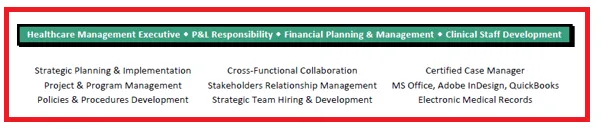
These keywords were previously missing in her resume, which was likely hurting her ranking in Applicant Tracking Systems.
Step 2: How to Create Accomplishments for Your Healthcare Executive Resume
After the resume is shortlisted by the ATS, it has to go through a human reader, like a recruiter or an HR Manager.
Therefore, your next task is to impress the recruiter within the mere few seconds they spend skimming through a resume.
The best way to do this is by replacing everyone-has-done-these responsibility statements with powerful accomplishments. Accomplishments are essential for resumes because they show an improvement trajectory. They show that you made things better for the organizations you worked at. They help prove to the readers that you’re a very strong candidate.
Take a look at this example. Which sentence makes the candidate seem stronger?
Before:
- Joint Commission initial and continual certifications, policy and procedure implementation and documentation.
- Staff education and Functional Independent Measure (FIM) credentialing.
After:
- Achieved $500K reimbursement held via Medicare auditing by aligning internal systems with audit needs; initiated the Target Probe and Education with Extrapolation (TPEE) program with medical representatives. The method was adopted regionally.
Quantitative accomplishments like improvements in patient care delivery, capital expansion, regulatory adherence, and cost reductions, are the best way of highlighting how you helped make things better.
However, where quantitative accomplishments are not applicable, qualitative accomplishments like process improvements and operational enhancements can work just as well to show how you used your skills to create bottom-line improvements for your company.
The following questions will help you identify your accomplishments:
Healthcare Process Improvements:
- What clinical process improvements did you introduce?
- Did you improve the quality of patient care delivery in any way?
- How did you ensure that your organization made advances in medical technology?
- What measures did you take to inform community members about important healthcare issues?
- How did you improve or maintain executive relationships with physicians?
- What strategies did you use to identify and mitigate risks?
- How did you ensure the professional development of your team members?
- What measures did you take to achieve the corporate vision and goal?
- Did you expand the capabilities of your organization? What roadblocks did you overcome to expand the capabilities?
Financial Development:
- Did you improve the capacity of your organization? How did you influence stakeholders in favor of your ideas?
- What strategies did you use to save costs and manage operations within budget?
- Did you enhance the operations by integrating technology?
- What strategies did you use to shorten the revenue cycle?
- Did you identify and capitalize on any business development opportunities?
- What new revenue streams did you develop?
- What improvements did you make to the facility and infrastructure?
- How did you ensure that your organization has a strong operational and financial footing?
- What short- and long-term capital plans did you make?
Hermione had a very impressive career history; it just wasn’t captured on her resume.
Asking some questions from the list above and then digging deeper into her history, I was able to unearth the following accomplishments for her. To see all of her accomplishments, check out the complete file here.
Make sure that all the keywords you selected from Step 1 are covered in the job experience.
Focus on writing everything first, then edit down to get to two pages; this will help you create a more powerful resume. You don’t want the editing (analytical) and writing (creative) parts of your brain to clash.
Moreover, you should include only relevant experiences in your resume.
When editing, think of yourself as a product and your resume as your sales pitch.
Step 3: Creating a Powerful Career Summary for a Healthcare Executive Resume:
Like most pieces of text, resumes are read most carefully towards the beginning and the rest is skimmed. This is likely how you read resumes when hiring, too.
The top portion of the resume, i.e. the first half of the first page, is where readers tend to pay the most attention. According to our research, this is the part that they remember most after reading, too. We call this the “visual center” of the resume.
If the visual center of your resume successfully grabs recruiters’ attention, they will read the rest of your resume a little more carefully instead of just skimming it.
To create an impactful visual center, add the following to the top of the resume:
- A brief summary statement that readers what key problem you solve. This article breaks down how to create a powerful summary statement.
- You can cut and paste three of your proudest accomplishments from the professional experience into the summary, or use a career summary proving why you are the best fit for the job.
- A list of skills.
After creating a visual center, read it out loud or have a friend read it. If it is interesting for you to read, then it will be interesting for your reader as well.
If you need more help with creating a strong summary for your resume, check out this article.
Hermione’s original summary was not capturing her strengths. It didn’t really differentiate her from other candidates. Most candidates competing with her can say they are able to “work closely with healthcare teams to build successful programs and operational foundations,” but most didn’t have Hermione’s unique experience improving the reach of programs over multiple states.
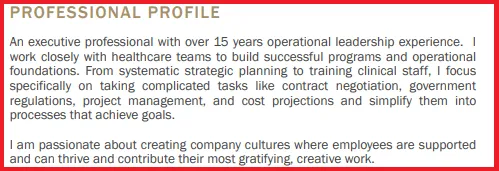
To make a solid first impression and maintain the reader’s attention, we made our point hard and fast. The result is as follows:
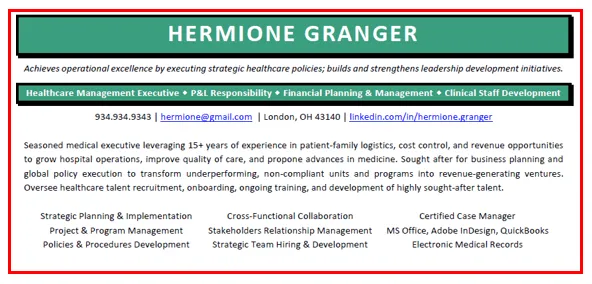
I chose to write a career summary that highlighted her extensive experience in the healthcare sector and the tasks she was most proficient in. The visual center also included a list of her best skills from Step 1. However, I avoided language that was full of adjectives and self-descriptors like “ambitious” and “dynamic” because recruiters consider these words cliché.
Use your summary to tell a story that proves that you are the best healthcare executive they will find. Make sure you include your proudest accomplishments. Do you expand business? Do you add revenue streams? Which organizational goals and objectives do you achieve? How do you grow the organization and your team?
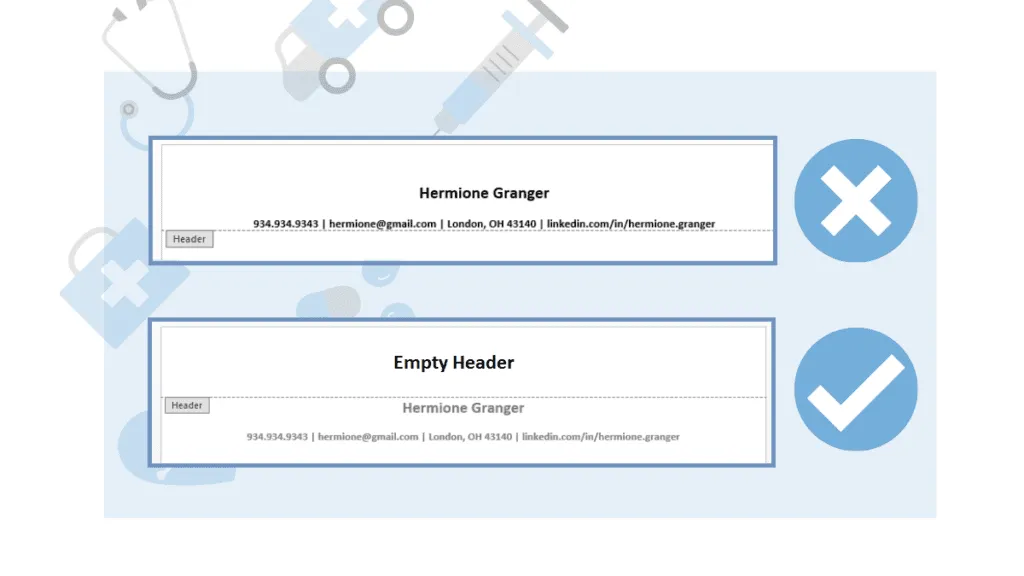
Another most important part of the visual center is the contact information. Many people throw the contact information into the header; information in headers and footers is not read by ATS. Therefore, contact information should be written clearly and on top of the resume page and should include your phone number, email address, city, state, zip code, and LinkedIn profile link.
Step 4: Using Healthcare Volunteer Experience and Projects:
If you have an employment gap in your resume, you may be giving recruiters the impression that your skillset is not up to date. A great way to cover them is to add projects and volunteer experiences to your resume.
If you have employment gaps in your career history, check out this article, which elaborates on various ways to covering them.
If you are interested in polishing your marketing skills by adding projects and volunteer experience sections to your resume, consider joining a healthcare professional association, such as the following:
- American College of Healthcare Executives (ACHE)
- Medical Group Management Association (MGMA)
- American Association of Healthcare Administrative Management (AAHAM)
Additionally, these are the most sought-after certifications if you’re interested in closing a skill gap through a formal program:
- Fellow of the American College of Healthcare Executives (FACHE) Certification
- Professional in Healthcare Information and Management Systems (CPHIMS) Certification
- Professional in Healthcare Risk Management Certification (CPHRM)
- Medical Manager Certification (CMM)
- American Association of Healthcare Administrative Management (AAHAM) Certification
Step 5: Making a Strong First Impression on LinkedIn:
LinkedIn is used as a sourcing tool by more than 94% of recruiters. Therefore, it becomes your first-ever impression when recruiters search for candidates.
LinkedIn Headline
The first thing recruiters see in your LinkedIn profile is your headline. Unfortunately, it is also the most neglected part; most people simply leave their job title on there and don’t add any additional keywords.
This does two things:
- It hurts your ranking on LinkedIn with respect to healthcare-related keywords.
- It is unlikely that people will click on your profile if your exact job title phrasing isn’t relevant to them.
Rather than seeing a headline like “Hospital Operations, St. Mary,” imagine if seeing something like the below. Wouldn’t you be much more interested in visiting the following peoples’ profiles?
- Healthcare Operations Management | Revenue Cycle Management | Market Trend Identification | Capability Expansion | Champions quality and safety while improving operational excellence.
- Hospital Director | Capacity Improvement | Revenue Growth | P&L Management | Regulatory Compliance Enforcement | Develops and implements value-based, patient-centric care delivery models.
LinkedIn Summary
The summary and professional experience sections each have a 2000-character limit. They give you more space than your resume to highlight your proudest accomplishments.
My favorite way to create a LinkedIn summary is as follows. I am using Hermione’s experience here to bring my concepts to life:
a) The first step is to pick the main idea that you want to focus on. What key skills have you demonstrated throughout your career?
For Hermione, I came up with, “I have a consistent history of improving care quality through strategic business planning and by transforming underperforming, non-compliant units and programs into revenue-generating ventures.”
b) Then, back up this main idea with three supporting ideas that show how you achieved your “main idea” in the past.
How 1: Maybe you identify revenue growth opportunities? If so, back up this statement with an example from your professional experience.
How 2: Maybe you develop and execute geographical expansion strategies? Again, if this applies to you, back it up with something from your professional experience.
How 3: Maybe you improve regulatory compliance and quality control?
The sky is the limit here. If you run out of ideas, check out the questions in Step 2.
c) Call to action: I usually like ending the summary with something like “Please send me a connection request if you are interested in growing your hospital’s reach with the help of a data-driven decision-maker.”
However, you can skip this step if you’d like not to advertise the fact that you’re looking for a job.
Writing is not everyone’s forte, but it is definitely mine. This is the reason my healthcare executive resume writing best practices have been approved by dozens of recruiters in the healthcare space. If you need help showcasing your skills and career history, check out my services here.