


What are the three types of executive resume formats?
Every resume falls into one of three structural categories. Each organizes the same information differently, and that difference changes how your candidacy is read by both software and humans.
Here is a quick comparison before we explore each executive resume format in detail:
| Chronological | Functional | Hybrid | |
|---|---|---|---|
| Structure | Work history listed newest to oldest | Organized by skills, minimal work history at bottom | Skills summary at top, followed by chronological work history |
| Best For | Steady career progression, same industry, no gaps | Extended gaps, highly fragmented history | Career transitions, senior executives, non-linear path |
| ATS Score | Excellent (96%) | Poor (66%) | Good (94%) |
| Recruiter Perception | Preferred by most recruiters | Viewed negatively by most recruiters | Generally positive |
| Pros | Easiest for ATS to parse. Shows clear career trajectory | Highlight transferable skills | ATS-compatible when structured properly. |
| Cons | Gaps and pivots are immediately visible | Most ATS systems struggle to parse. | Requires careful structuring to avoid repetition |
The chronological executive resume format
The chronological resume format lists work experience from most recent to oldest. It is the format every major ATS platform is built to parse and the one most recruiters expect to see at the senior level.
Section layout for a chronological executive resume
- Contact information: your name, phone number, email, and LinkedIn URL should appear on the first one or two lines of the document. Never place them inside a Word or PDF header element as most ATS platforms skip header and footer entirely and will process your resume as if it belongs to an anonymous candidate.
- Executive summary (3 to 4 sentences.)
- Work history section: reverse time order, quantified accomplishments under each role.
- Key skills.
- Education and certifications.
Advantages of the chronological format:
- Highest ATS parse rate at 96% across all major platforms.
- Career progression and increasing P&L scope read clearly through a visible timeline.
- Recruiters scan your most recent role and assess seniority in seconds.
- No red flags. The format does not trigger the “what are they hiding?” reaction from recruiters
Disadvantages of the chronological format:
- Employment gaps are front and center before your strongest material.
- A lateral move or industry pivot looks like a step back in a purely chronological structure.
- Board roles, advisory positions, and consulting engagements sit awkwardly inside a traditional timeline.
- Strategic competencies get buried under decades of role-by-role detail.
The functional resume format:
The functional executive resume format organizes content around skill categories rather than employment history. Instead of listing roles in order, you group accomplishments under headings like Strategic Planning, P&L Management, or Cross-Functional Leadership. A brief work history is added at the bottom with company names, titles, and dates only.
Section layout for a functional resume:
- Contact information: your name, phone number, email, and LinkedIn URL.
- Executive summary or objective.
- Skill category 1 (e.g. Strategic Planning): 3 to 4 bullet accomplishments.
- Skill category 2 (e.g. P&L Management): 3 to 4 bullet accomplishments.
- Skill category 3 (e.g. Cross-Functional Leadership): 3 to 4 bullet accomplishments.
- Employment history: company name, title, and dates only, no bullet points.
- Education.
Advantages of the functional format:
- Skills and accomplishments lead without a timeline attached.
- Employment gaps are less prominent since work history is secondary.
- Consolidates diverse or fragmented experience into a coherent narrative.
Disadvantages of the functional format:
- Most ATS systems cannot correctly extract work history, scoring it at 66% accuracy.
- Most recruiters view it negatively, reading it as a signal that something is being concealed.
- Skills without context raise more questions than they answer. “Managed a $50M P&L” means very little without knowing where or when.
The functional format is rarely the right choice at the executive level. Instead, the hybrid format achieves the same goal of surfacing skills prominently while keeping the structured work history that both ATS systems and senior recruiters require.
The hybrid executive resume format:
The hybrid executive resume format leads with a core competencies section, then follows with a full reverse-chronological work history. It gives ATS systems the structured work history they need while putting your strategic positioning in the first third of the page.
Section layout for a hybrid executive resume:
- Contact information: your name, phone number, email, and LinkedIn URL.
- Executive summary (3 to 4 sentences, keyword-rich.)
- Core competencies or key skills (keyword grid.)
- Work history section: full chronological detail with quantified accomplishments.
- Education and certifications.
- Board roles or advisory positions if applicable.
Advantages of the hybrid format:
- Keywords appear twice: in the competencies section and inside experience bullets, boosting ATS match scores.
- Strategic positioning appears above the fold before the recruiter reaches your work history.
- Career gaps are present but not the first thing a reviewer sees.
- Board experience and consulting work have a natural home in a dedicated section.
- Most versatile format for the complexity of a 20-plus year executive career.
Disadvantages of the hybrid format:
- Runs slightly longer than chronological, requiring discipline to stay within two pages.
- A poorly structured hybrid feels repetitive if the skills section and work history bullets cover identical ground.
How does each executive resume format perform across ATS platforms?
Not every ATS treats every format the same. The chronological versus hybrid decision shifts by platform, especially at the enterprise level where most executive roles are posted.
| ATS Platform | Chronological | Hybrid | Functional | Notes |
|---|---|---|---|---|
| Workday | 96% | 93% | 78% | Used by most large enterprises. Some configurations auto-reject resumes with missing dated entries |
| Greenhouse | 97% | 95% | 85% | Common in tech and scale-ups. No auto-rejection; human reviewers screen all formats |
| Lever | 96% | 94% | 84% | Common in startups. AI parser handles all formats but scores functional lower |
| iCIMS | 95% | 92% | 80% | Some configurations penalize functional resume format via Boolean date checks |
| Oracle Taleo | 94% | 88% | 70% | Legacy enterprise system. Auto-rejects approximately 30% of functional resumes. Newer Oracle Recruiting Cloud performs closer to iCIMS levels |
| SAP SuccessFactors | 95% | 91% | 75% | Widely used by global Fortune 500 companies. Functional format triggers lower relevance scores due to missing dated work history |
Sources: Resume Optimizer Pro 2026 benchmark testing, ResumeAdapter Q1 2026 pipeline analysis, Jobscan State of the ATS 2025.
Chronological and hybrid formats parse at 88 to 97% across all six major platforms. Functional drops to 70 to 85% and carries auto-reject risk on Workday and Taleo. If you do not know which ATS a company uses, both chronological and hybrid are safe choices, functional is not.
Which executive resume format works best for your industry?
Different industries carry different format expectations at the senior level.
Finance and Professional Services
Recommended: Chronological.
CFOs and finance executives benefit from a clear timeline of increasing P&L scope. Conservative industries expect firm names, titles, and quantified financial outcomes in a predictable structure.
Technology and Engineering
CIOs, VP of Engineering, and Chief AI Officers need a skills-forward format that surfaces technical depth before the work history. A competencies block covering cloud infrastructure, enterprise AI strategy, and platform modernization signals executive capability immediately.
Communications and Corporate Affairs
CCO and VP of Communications candidates benefit from leading with integrated communications, stakeholder management, and crisis communications before their role-by-role history.
Sales and Revenue Leadership
VP of Sales and Chief Revenue Officer candidates need GTM strategy and enterprise sales leadership keywords visible before the reviewer reaches individual deal details.
Non-Linear Careers
Candidates with varied backgrounds across industries or functions benefit from a competencies-led format that consolidates transferable skills into a coherent leadership story before the reviewer encounters the timeline.
Which executive resume format fits your career stage?
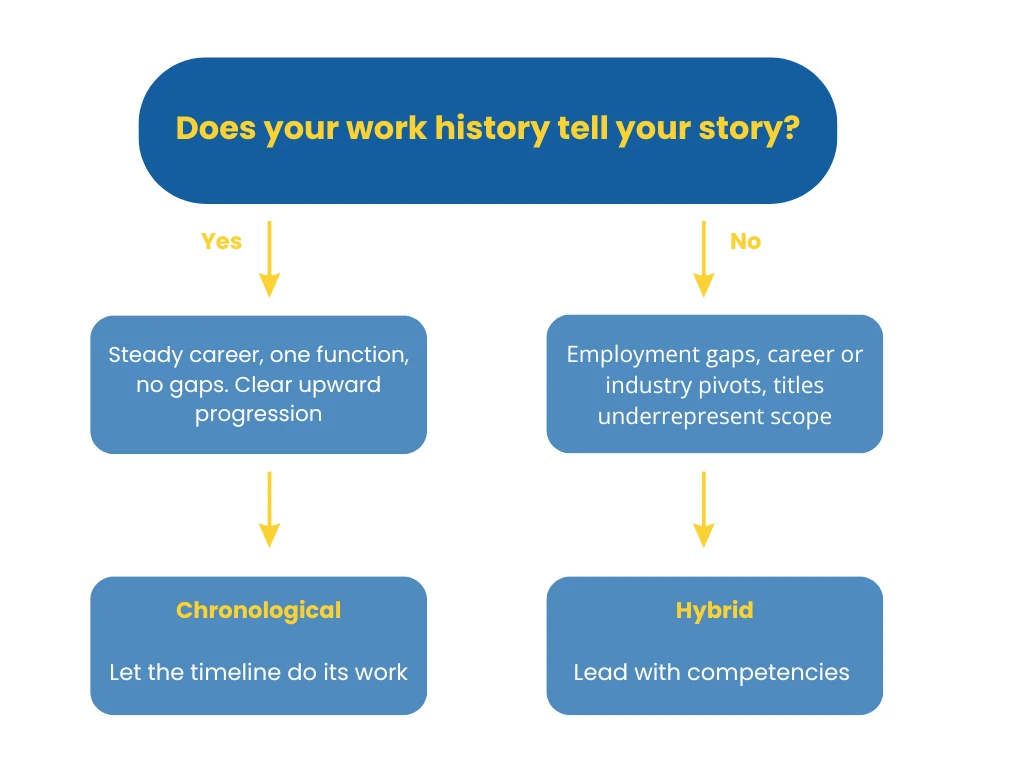
The decision comes down to one question: does your work history tell your story, or does it work against you?
If your career has followed a clear upward path within one function or industry, the chronological format is your strongest choice. Your progression is visible, your P&L scope grows with each role, and the timeline itself signals seniority. A CFO who moved from Finance Director to VP of Finance to CFO across three companies does not need to lead with a competencies block. The work history section does that work automatically.
If your career is more complex, the hybrid format serves you better. This includes executives with employment gaps, those transitioning from an operational role to a board or advisory position, leaders who have moved across industries, and anyone whose job titles do not fully reflect the strategic scope of their work. The hybrid format lets you establish your executive positioning before the reviewer reaches your timeline.
The one format to avoid at the executive level is functional. Leading with skill categories and minimizing your work history raises more questions than it answers at the senior level. Recruiters and board members want to know where you did it and when, not just that you did it. A hybrid format achieves everything a functional format attempts, with far better ATS compatibility and far less recruiter skepticism.
How to turn your executive resume format into a career positioning tool?
Most executives default to the format they used last time. At the senior level, that costs interviews. The right executive resume format depends on your career trajectory, your target role, and whether your work history helps or works against you.
Choosing and executing the right format is a process. A senior executive resume writer at CareerTuners will:
- Assess your career situation and identify which executive resume format fits your goals.
- Build your resume inside an ATS-compatible single-column template that has been approved by 3000+ recruiters.
- Write for the ATS first, using standard section headings, consistent dates, and strategic keyword placement, then polish for the human reviewer.
- Check ATS compatibility against your target job descriptions to identify and close keyword gaps.
- Tailor your summary, competencies, and key bullets for each application so your resume scores well every time it is scanned.
You have spent years earning your position. Let us make sure your resume reflects that. Upload your resume here to uncover gaps in your current resume. Our experts provide actionable feedback to ensure your resume stands out from the competition, gets through ATS, and lands in front of decision-makers.
Frequently Asked Questions
The hybrid executive resume format is the best choice for most senior leaders. It leads with a competencies section that captures ATS keywords and positions your strategic value for human reviewers, then follows with a full reverse-chronological work history. Executives with a clean, linear career in one industry may prefer chronological, which parses at 96% accuracy across major platforms.
The three types are chronological, functional, and hybrid. Chronological lists work history in reverse time order and is preferred by most recruiters. Functional organizes content by skill categories and is viewed negatively by 63% of recruiters. Hybrid combines a skills summary with full chronological work history and is the most versatile option for executives.
Yes. A properly structured hybrid executive resume format parses at 94% accuracy across major ATS platforms, close to chronological’s 96%. The key is to include a complete work history section with standard headings, consistent dates, and quantified accomplishments beneath your skills summary.
The hybrid executive resume format handles career gaps most effectively. Leading with a strong competencies section draws attention to your strategic value before the reviewer reaches your timeline. A senior executive resume writer can help frame gaps as part of a coherent leadership narrative rather than a red flag.
Yes, particularly if your career is non-linear, you are targeting a different function or industry, or your resume is not generating interviews. A senior executive resume writer understands how different ATS platforms score each executive resume format and how to position your story for specific target roles.
The format can stay consistent, but the content within it should not. ATS systems score your resume against each specific job description. Keep your base executive resume format and adjust your summary, reorder competencies, and tune two or three bullets in your most recent role to match each target position.