


How does ATS parsing work for engineering resumes?
Applicant tracking systems work a lot like a search engine. A recruiter sets up filters that reflect the job requirements, and the ATS pulls every resume it judges to be a match. Those filters are built around keywords, and understanding how to extract and place them is the difference between a resume that gets seen and one that disappears.
Hard keywords are skills you could be tested on directly. Things like circuit design, FEA, SolidWorks, GD&T, or a specific programming language. You can usually find them by scanning the “Requirements” or “Qualifications” section of a job posting.
Soft keywords, like leadership or cross-functional collaboration, matter too, but only when backed by a specific accomplishment. Simply stating “strong leadership skills” does nothing. A bullet like “led an initial response team of 5 engineers to redesign the emergency response plan” proves it.
Consider the qualifications section of this job for Director of Engineering and Operations:
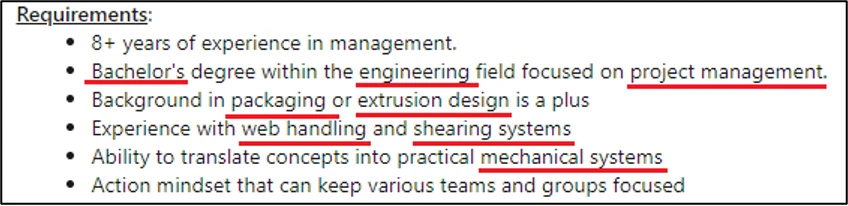
Hard Keywords: Bachelor, Engineering, Project Management, Packaging, Extrusion Design, Web Handling, Shearing Systems, Mechanical Systems.
The job title trick most engineers miss:
Recruiters also search by job title, not just skills. If a posting is for a “Director of Engineering” and your resume says “Principal Engineer,” you may rank lower in the ATS even when your actual responsibilities matched or exceeded the role.
The workaround: list your target title in parentheses next to your actual title.
Job Title (Target Job Title Roles), Company Name
E.g.: Principal Engineer (Director of Engineering Roles), Unilever
This only works if your real scope of work supports the claim. Do not use this trick to inflate a title beyond what your responsibilities can back up. It is meant to help the ATS recognize equivalent experience, not to misrepresent your level.
Formatting rules that protect your parse rate:
- Use a reverse chronological format with a single-column layout.
- Structure your work experience section with company name, title, dates, and bullet points under each role.
- No two-column designs, embedded graphics, or text boxes.
- No tables with more than one row.
You can learn more ATS-friendly resume formatting tips in this guide.
What to include in an engineering resume: examples by career level
Here is what each career stage needs to show, with a real example at each level.
Entry-level engineering resume: recent graduate
At the entry level, lead with education rather than work history. Internships, co-ops, student design teams, and capstone projects carry real weight and should be written like professional accomplishments: problem, action, result.
A common mistake recent graduates make is listing projects with no result attached. “Built a tilt-sensing game controller using Arduino” tells a recruiter what you did but nothing about what it accomplished. Reframe each project to show the skill applied and the outcome achieved.
Professional summary:
Electrical and robotics engineer specializing in power electronics, automation, and hardware-software integration across academic research and industry internships. Designs, builds, and tests scalable systems by leveraging advanced simulation and prototyping tools.
Two bullets, each demonstrating a different skill:
- Hardware Design Optimization: Increased motor thrust by 300%, from 10N to 3kN, by replacing the gas motor with a Linear Induction Motor (LIM); built electrical and magnetic simulations using Ansys Maxwell.
- Automated Solution Development: Sped up defect mitigation by reducing data collection and analysis time from approximately two days to a few minutes by introducing automation through a custom Python script.
Mid-level engineering resume: 3 to 8 years of experience
At the mid-level, the resume needs to show ownership, not just participation. This is where “supported” and “assisted” language should shift to “led” and “directed,” but only where the experience genuinely supports it.
Quantify everything you can. If you cannot recall the exact figure, an approximation like “reduced costs by roughly $400K annually” is still far stronger than an unquantified claim.
Professional summary:
Industrial engineer specializing in warehouse operations optimization, quality control engineering, and program management across automated and high-volume distribution environments. Drives double-digit productivity gains and cost reductions through workflow optimization and cutting-edge technology implementation, with a track record of leading network restructuring and process improvement initiatives that scale across multiple facilities.
Two bullets, each demonstrating a different skill:
- Cost and Efficiency Optimization: Directed a $14M network-wide cost-saving initiative, building cost models based on Engineered Labor Standards and leading the completion of cost-per-piece analyses.
- Team Leadership: Developed and mentored a team of 5 direct reports, improving new engineer onboarding by creating and leading training sessions on industry-specific tools.
Senior engineering resume: principal or level 5 engineer
At the senior or principal level, the resume needs to demonstrate technical authority, not just technical skill. This is the engineer other engineers and program managers defer to. Credentials, delegated authority, and influence across multiple programs matter more here than a long list of software tools.
Professional summary:
Electrical systems engineer specializing in hardware qualification, RF/communications systems, and end-to-end systems certification across space, defense, and commercial aviation programs. Leads EMI/EMC qualification, supplier technical management, and system-level acceptance with high autonomy across mission-critical programs, delivering from requirements through system acceptance in cross-functional, fast-paced environments.
Two bullets, each demonstrating a different skill:
- Innovation and Process Standardization: Reduced EMI emissions by 3 to 4 dB by co-inventing a shielded equipment installation solution, validated during qualification testing and awarded a patent.
- Program Leadership: Served as the systems integration authority within a 25-person cross-disciplinary program team, leading equipment qualification and providing technical direction through certification delivery.
Director and VP of engineering resume
At the director and VP level, the resume needs to read like a business case, not a technical one. Hiring decisions here are made by people who care about revenue, organizational scale, and strategic direction more than the specific tools used to get there.
Professional summary:
Engineering executive with a PhD in AI and 15+ years of experience in leading globally distributed engineering organizations, defining multi-year technical roadmaps, and delivering resilient platforms at scale across cloud-native, microservices, and hybrid environments. Track record of building high-performing teams, embedding SRE principles for service reliability, integrating data platforms and enterprise systems, and driving AI-enabled capabilities across the SDLC.
Two bullets, each demonstrating a different skill:
- Organizational Scaling: Scaled a global engineering organization from 50 to 150+ staff members via a hybrid talent model spanning Eastern Europe, India, and in-house teams.
- Revenue Impact: Drove $64M SaaS ARR growth by productizing the patent portfolio and embedding commercially viable AI capabilities across 9 product lines.
How do you write an engineering resume for a career change?
Engineers changing industries often make one mistake: their resume stays anchored to the field they are trying to leave.
We worked with an engineer transitioning out of nuclear power plant management entirely. His original resume buried strong, transferable wins under nuclear-specific terminology, and most bullets described duties rather than results.
Before:
Responsible for managing daily operations of nuclear power plant systems and ensuring regulatory compliance.
After:
Improved equipment reliability by 18% and strengthened employee safety protocols across plant operations, reducing unplanned downtime and audit findings.
How to do this for your own resume:
- Identify the underlying skill behind each accomplishment: problem-solving, systems thinking, or process optimization, rather than the industry-specific tool or context.
- Pull keywords directly from job postings in your target field and compare them against your current resume.
- Reframe each bullet around the result, not the domain it happened in.
You do not need a perfect keyword match. If you recognize roughly half the keywords in a target posting, you are a reasonable candidate, and the resume’s job is to prove the capability transfers.
How do you make an engineering resume AI-ready in 2026?
The resumes that score highest in 2026 are not the ones with the most keywords, but the ones where every keyword is backed by a result. This is because many platforms have moved toward semantic and contextual matching. This means that the system evaluates whether your experience genuinely supports the claims you are making, not just whether the right words appear on the page.
Here are the AI resume screening tips engineers need to know in 2026:
- Back every keyword with a result: Stop listing “Python” in a skills section with nothing behind it. Show it inside a bullet: “Automated defect analysis using Python, cutting review time from 2 days to under 10 minutes.”
- Repeat each keyword 2 to 3 times, no more: Aim for each core keyword to appear 2 to 3 times across the resume, in different contexts. Beyond that, platforms like Workday actively flag the term as potential manipulation.
- Use close variations of the same term: Use the exact terminology from the job posting at least once, then vary it elsewhere. “Six Sigma” in your summary and “DMAIC methodology” in a bullet both register as related expertise to a semantic parser.
How do you fix an engineering resume that is not getting interviews?
Most engineers do not lose interviews because their experience is weak. They lose them because their resume reads like a technical specification instead of a business case. Whatever stage you are at, the resume needs to speak the language of the person making the hiring decision.
A professional engineering resume writer at CareerTuners can help you translate your technical depth into a resume that clears ATS and gets read by the people who are actually making the decision. Get a free resume review and find out exactly where your current resume is falling short.
FAQs
A clean, single-column reverse chronological format remains the safest choice. Avoid two-column layouts, graphics, and tables, which cause ATS systems to misread your work experience section, dates, and titles entirely.
At minimum, include a professional summary, a technical skills section, a work experience section with quantified accomplishments, education, and relevant certifications. What gets emphasized shifts significantly by career level, from projects and coursework early on to organizational and revenue impact at the director and VP level.
Lead with transferable accomplishments rather than domain-specific tools. Identify the underlying skill behind each result and reframe it using language and keywords from your target industry’s job postings.
Yes. A 3 to 4 sentence professional summary at the top of your resume gives both the ATS and the hiring manager immediate context on your experience level, core skills, and biggest accomplishment before they read a single bullet point.
If your resume is not generating interviews despite strong qualifications, a professional engineering resume writer can help translate technical depth into the business impact language hiring managers and ATS systems are looking for. This is especially valuable during a career change or a move into senior leadership.
One page is typical for recent graduates. Two pages is standard for mid-level through senior engineers. Director and VP-level resumes can run to three pages when patents, board roles, or extensive organizational scope are directly relevant to the target role.