


When should you include engineering projects on your resume?
You should add engineering projects on your resume when they add something the work experience section cannot. For recent graduates and engineering students, that is almost always. For mid-career and senior engineers, work history carries the weight and projects move into the background or disappear entirely.
Include an engineering projects section if you are:
- A student or recent graduate with limited professional experience.
- An early-career engineer whose academic or personal projects demonstrate skills not yet reflected in your work history.
- A career changer using projects to prove technical competence in a new domain.
- A freelance or contract engineer whose work was entirely project-based.
Once you have five or more years of relevant work experience, engineering projects rarely need their own section. Initiatives, system builds, and technical implementations become part of your work history bullets as proof. For a full guide on how to structure your engineering resume at every career stage, see our engineering resume writing guide.
Where should engineering projects go on your resume?
Placement depends on your career stage and the nature of the project. Here is a simple decision framework:
| Your Situation | Where to place projects |
| Student or recent graduate | Dedicated projects section or education section |
| Final year project or capstone | Education section, directly under your degree |
| Freelance or contract engineer | Work experience section, formatted like a role |
| Career changer with no relevant work history | Dedicated projects section near the top |
| Personal or GitHub projects | Additional section at the bottom |
| 5+ years of professional experience | Embedded in work history bullets, not a separate section |

How to list engineering projects on your resume
Each engineering project entry should include the project name, your role, the tools used, and at least one quantified outcome. The exact format can vary but all four elements need to be present.
Three rules that separate strong engineering resume projects from weak ones:
- Lead with the result, not the task: A hiring manager does not need to know that you built a robot. They need to know what the robot did, how well it performed, and what technical decisions you made to get there.
- Name tools specifically, not generically: “Used CAD software” tells an ATS nothing. “Designed in SolidWorks with ANSYS structural validation” tells an ATS and a hiring manager exactly what you know. Specific tool names are the hard keywords that engineering resume ATS scans look for.
- Quantify wherever possible: Time saved, accuracy improved, cost reduced, efficiency gained. Even academic projects have measurable outcomes: a grade, a competition placement, a percentage improvement in simulation accuracy
Engineering resume projects section examples by discipline
Projects carry different weight and take different forms depending on your engineering discipline. Here are real examples from resumes we have written.
Mechanical Engineering Projects Resume
At the graduate level, thesis projects carry the most weight in a mechanical engineering resume projects section. They demonstrate independent technical judgment, tool proficiency, and the ability to see a complex engineering problem through to a validated outcome.
Notice what this resume does well:
- Each project is treated as a standalone entry with its own title, tools, and outcome-focused bullets rather than a general description of coursework
- Tool names are specific: SolidWorks, MATLAB Simulink, MATLAB Simscape, PID Controllers, not “CAD software” or “simulation tools”
- Grades are included as a credibility signal in the absence of professional performance metrics
Electrical Engineering Projects Resume
For electrical engineering students and recent graduates, a projects section that spans academic research, competition engineering, and personal builds demonstrates range across hardware, simulation, and systems work.
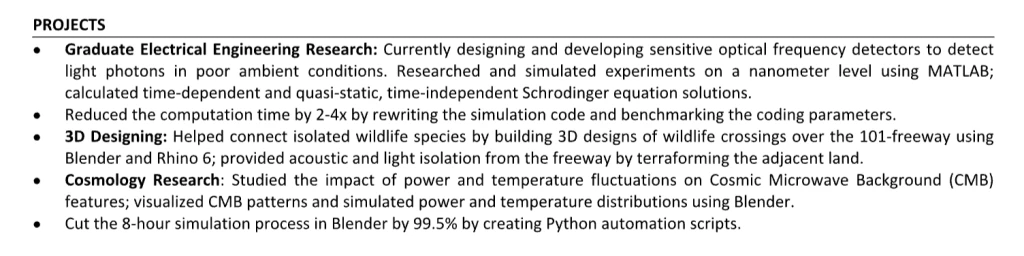
Notice what this resume does well:
- Projects span multiple contexts: graduate research, a national competition, and independent work, showing technical range beyond the classroom.
- Every bullet leads with a quantified outcome: 300% thrust increase, 99.5% simulation time reduction, $20K in prevented costs.
- The competition project includes the candidate’s specific role, Chief Propulsion Engineer, which signals leadership alongside technical contribution.
Software Engineering Projects Resume
For software engineering students and bootcamp graduates, a dedicated projects section with deployed applications and GitHub links replaces the traditional work experience section. Each entry shows the stack used, what was built, and how it performs in production.
Notice what this resume does well:
- Every project is deployed and linked, turning the projects section into a live portfolio rather than a list of descriptions.
- The tech stack is listed specifically for each project rather than consolidated into a generic skills list at the bottom.
- Project names are descriptive and professional, signaling product thinking rather than academic exercise.
Civil Engineering Projects Resume
Civil engineering academic projects often sit inside the education section rather than a standalone projects section. This is the right placement for capstone work, thesis projects, and award-winning research completed as part of a degree program.

Notice what this resume does well:
- Projects are placed directly under the relevant degree rather than in a separate section, keeping the academic context intact.
- Each project entry includes a specific outcome: a competition placement, a methodology recommendation, a cost estimate.
- The scope of each project is clear from the first line: a real road rehabilitation in Texas, the structural analysis of a landmark building
What not to include in your engineering projects section
- Projects with no outcome or result attached. “Built a robot” with nothing behind it adds no value.
- Outdated projects using deprecated tools that are no longer relevant to your target roles.
- Projects already covered in your work experience section. Repetition wastes space and dilutes impact.
- Every project you have ever completed. Pick the two or three most relevant to the role and cut the rest.
- Vague tool descriptions. “Used software to model the design” should always be replaced with the specific tool name.
How do you make your engineering resume projects section stand out
A strong engineering projects section does not just fill space on a resume. It bridges the gap between what you have studied and what you can deliver. At the student and early-career level, that bridge is often what gets you the interview.
The engineers whose project sections land interviews are not necessarily the ones with the most impressive projects. They are the ones who frame their work in terms a hiring manager can act on: what was built, which tools were used, and what changed as a result.
If you are not sure whether your projects section is doing that effectively, our engineering resume writer can audit your resume and rebuild your projects section. They’ll make sure your technical work is positioned to clear ATS and compel the hiring manager on the other side. Get a free resume review and find out exactly what is holding your resume back.
Frequently Asked Questions
If you are a student, recent graduate, or early-career engineer with limited professional experience, yes, you should. A well-structured engineering projects section can demonstrate hands-on technical skills that your work history cannot yet reflect. If you have five or more years of relevant experience, your work history carries that weight and a separate projects section is usually unnecessary.
Place it in your education section directly under your degree, formatted with a project title, tools used, and two to three bullets showing what you built and what the outcome was. If your final year project is substantial, it can anchor a dedicated projects section near the top of the resume instead.
Include your GitHub URL in your resume header alongside your LinkedIn and contact details so ATS systems can extract it correctly. Then reference specific repositories in your projects section with the project name, tools used, and quantified outcomes. A GitHub link alone without project context does not tell a hiring manager what you built or what it achieved.
Two to four projects is the right range for most engineering students and early-career engineers. Prioritize depth over breadth: two well-documented projects with clear outcomes outperform six brief mentions. Tailor the selection to the role, keeping projects that use the tools and skills the job posting names and cutting the rest.
If your projects section is not generating interviews despite strong technical work, the issue is usually framing rather than substance. An engineer resume writer can help you translate academic and personal projects into the outcome-focused language that hiring managers and ATS systems respond to. Get a free resume review and find out exactly where your projects section is falling short.